
How is it that you can hear, but not understand? This is one of the most common complaints I hear before people decide to treat their hearing loss. To understand why this happens, we need to take a closer look at an audiogram. If you’re unfamiliar with how to read an audiogram, I wrote a blog titled ‘Understanding your Audiogram’ which I recommend your read. Take a look at the audiogram below.
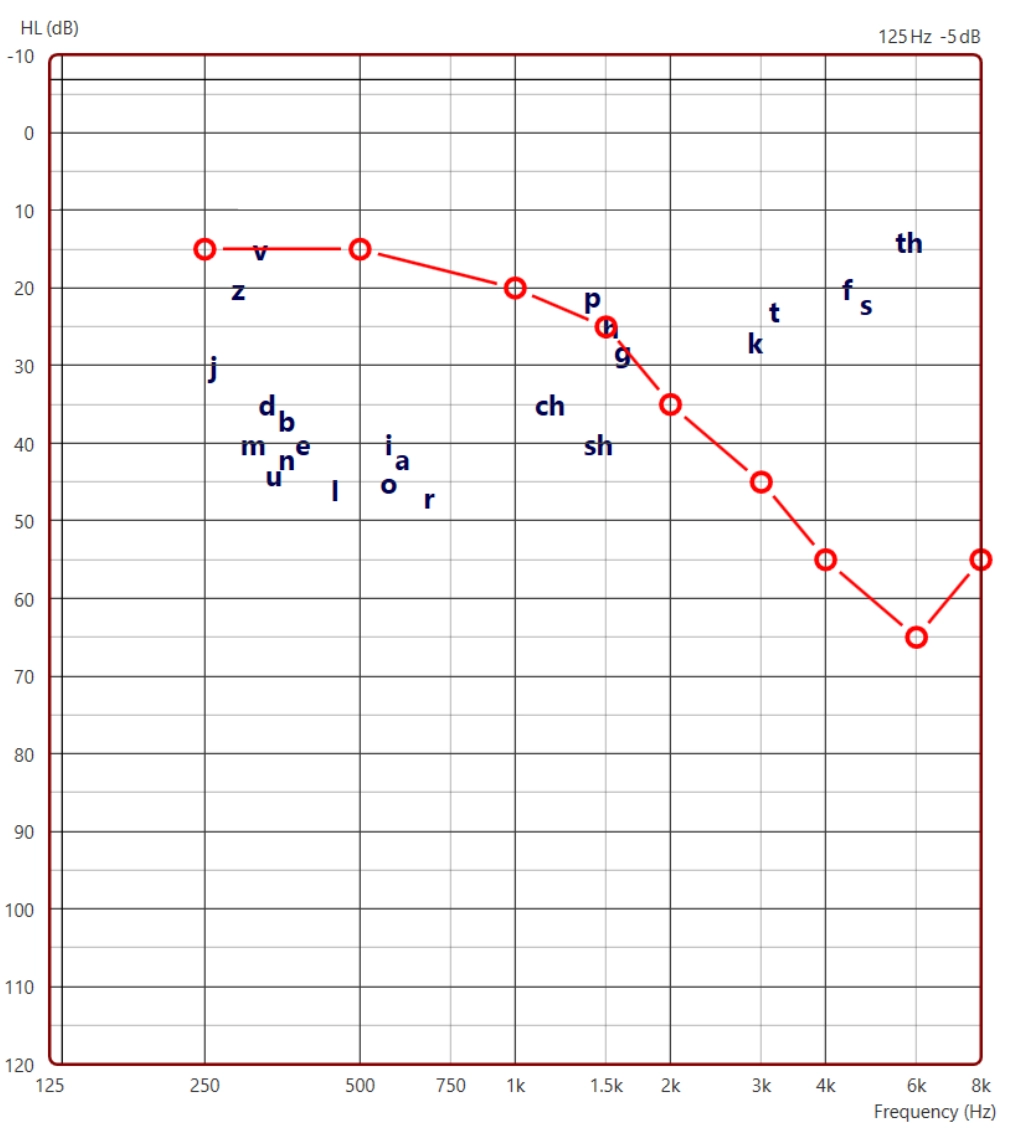
A quick refresher: An audiogram tells you how loud a certain sound/pitch needs to be in order for the subject to be able to hear it. In the graph above, we are looking at an audiogram for someone’s right ear. The red line indicates their hearing thresholds – the lower the red circle is at any given pitch, the louder it has to be for them to hear it. This means that the region above the red line is inaudible to that person. Notice the letter – They represent the different speech sounds (or phonemes). They tell us how loud and at what pitch each speech sound is on average. That means that all the letters that are below the red line are perfectly audible, but all the letters that are above cannot be heard.
For this particular subject words like ‘fake’ might often be misheard and confused with words like ‘fate’ , faith’ , ‘‘face’ or ‘safe’! Notice that the vowel sound (in this case, the ‘A’ on the lower left of the graph) is below the red line and therefore audible, yet the higher-pitch consonant sounds that form the beginning and end of the word are not.
How does the brain cope?
When we can’t hear a certain proportion of speech sounds your brain goes into overdrive – working harder than it otherwise would to make sense of incomplete information. How does it do this? The brain starts to bring other cognitive faculties onboard in order to fill in the missing information that your ears are failing to provide – it starts to look to the visual system in order to glean missing information by lip-reading.
Additionally, it works as a predictive engine that takes into account the context of the conversation to make educated guesses as to what misheard words may likely have been, and hopes, for fear of embarrassment that it’s correct. But all this extra work leads to additional mental effort and eventual fatigue. Soon enough, it becomes easier to sit back, withdraw, or avoid social occasions altogether.
What can be done about it?
When a hearing aid is appropriately calibrated, it’s designed to amplify the speech sounds that are inaudible to you (i.e. the letters that sit above your audiogram) so that they are more accessible.