You’ve had your hearing test. You’ve been handed a graph. And now you’re wondering… what exactly am I looking at?
An audiogram might look technical, but once you understand a few basics, it becomes much easier to interpret. Let’s break it down.
First: What Is an Audiogram?
An audiogram is simply a map of your hearing sensitivity. It doesn’t tell us how well you process speech or how well you can focus on speech in noisy environments – it’s simply indicating how loud a sound needs to be for you to be able to hear it. It shows:
- Pitch (frequency) — what tones you can hear
- Volume (intensity) — how loud sounds need to be at a given pitch for you to be able to detect them
Step 1: Understand the Horizontal Line (Across the Bottom)
This line shows pitch, measured in Hertz (Hz).
- Numbers on the left (250–500 Hz) represent lower-pitched sounds
- Think: Bass guitar, rumbling thunder, lower pitch vowel sounds
- Numbers on the right (4000–8000 Hz) represent higher-pitched sounds
- Think: Treble, birds chirping, children’s voices, consonants like “s,” “f,” and “th”
When it comes to hearing speech, a simple and easy way to break it down is to consider that the low-frequencies give speech it’s volume, whereas the high-frequency sounds give speech it’s clarity and distinction. This is why high-frequency hearing loss often results in people saying things like, “I can hear people talking, but I can’t understand them.”
Step 2: Understand the Vertical Line (Down the Side)
This line shows volume, measured in decibels (dB).
- The top of the graph (-10 to 20 dB) indicates softer sounds
- The bottom of the graph (70–100+ dB) indicates very loud sounds
The lower down your scores sit on the graph, the louder the sound had to be (at that pitch) before you could hear it. In simple terms – the lower on the graph your results sit, the poorer your hearing.
Step 3: Look at the Symbols
On you’re audiogram, you’ll usually see lines that are marked with either:
- O = Right ear
- X = Left ear
Your audiologist may also include additional symbols for bone conduction testing which look like arrow heads, such as < >, or [ ]. These helps determine whether the hearing loss is caused by damage to the inner ear (cochlea), an issue in the middle ear, or both. However, to get a simplified and easy-to-understand grasp of your audiogram we can ignore the bone conduction and just focus on the O’s and X’s.
Step 4: Identify the Pattern
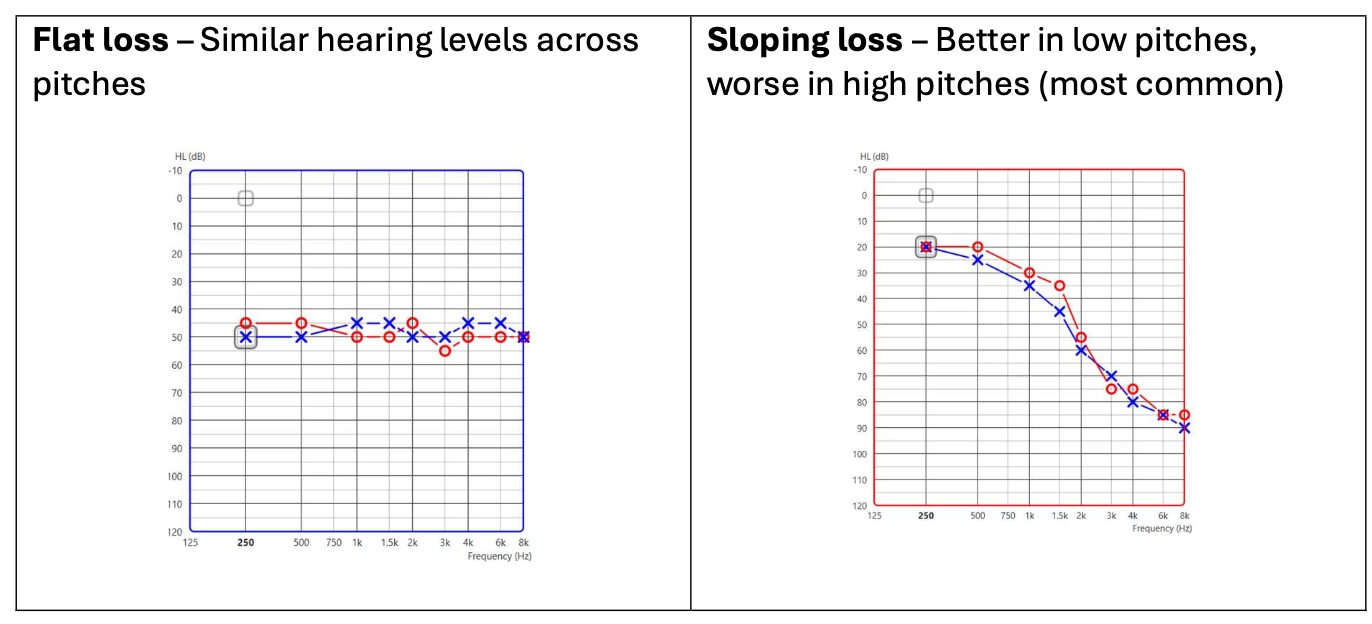
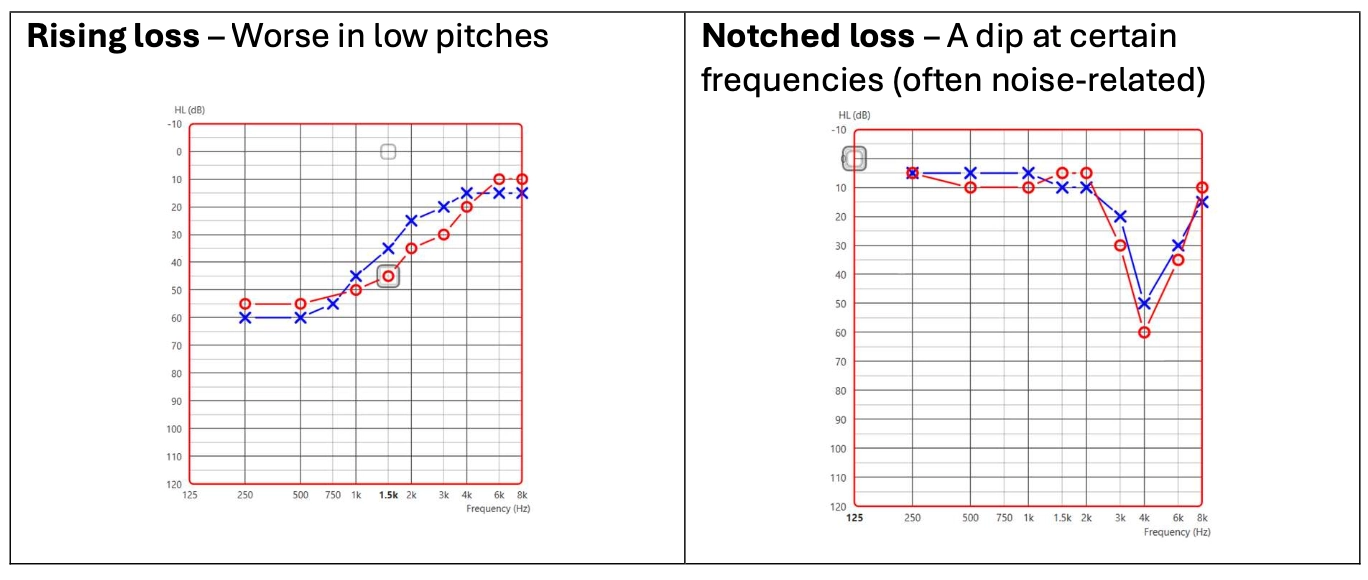
Now zoom out and look at the overall shape. Common patterns include:
- Flat loss – Similar hearing levels across pitches
- Sloping loss – Better in low pitches, worse in high pitches (most common)
- Rising loss – Worse in low pitches Notched loss – A dip at certain frequencies (often noise-related)
- How do we classify the degree of hearing loss
How do we classify the degree of hearing loss
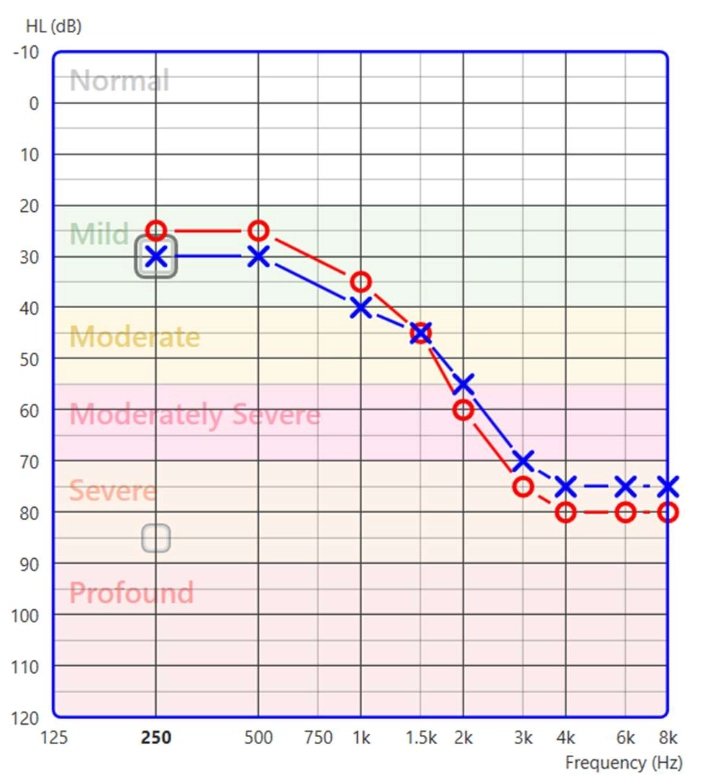
Hearing losses are generally classified using the terms mild, moderate, moderately- severe, severe and profound, depending on how far down the graph your thresholds are. Most hearing losses will pass through multiple categories – for example, here an example of a mild sloping to severe hearing loss:
It is important to note that two people with the same audiogram can experience very di erent levels of di iculty. An audiogram only tells us what you can detect in a quiet room through headphones. It does not tell us how you cope in noise, how well your brain can process the complex and subtle patterns of speech, how fatigued listening makes you, or how it impacts your relationships.
That’s where a thorough discussion, comprehensive assessment, and a skilled audiologist becomes essential. Your audiologist needs to interpret multiple di erent tests in combination before planning your treatment.
At Holistic Hearing, we employ a constellation of tests to gain a robust understanding of not only the degree of your hearing loss, but also your ability to process speech in quiet AND in noise. This information forms the solid foundation required to successfully treat any hearing loss.